How this feature connects to others
Feature overview
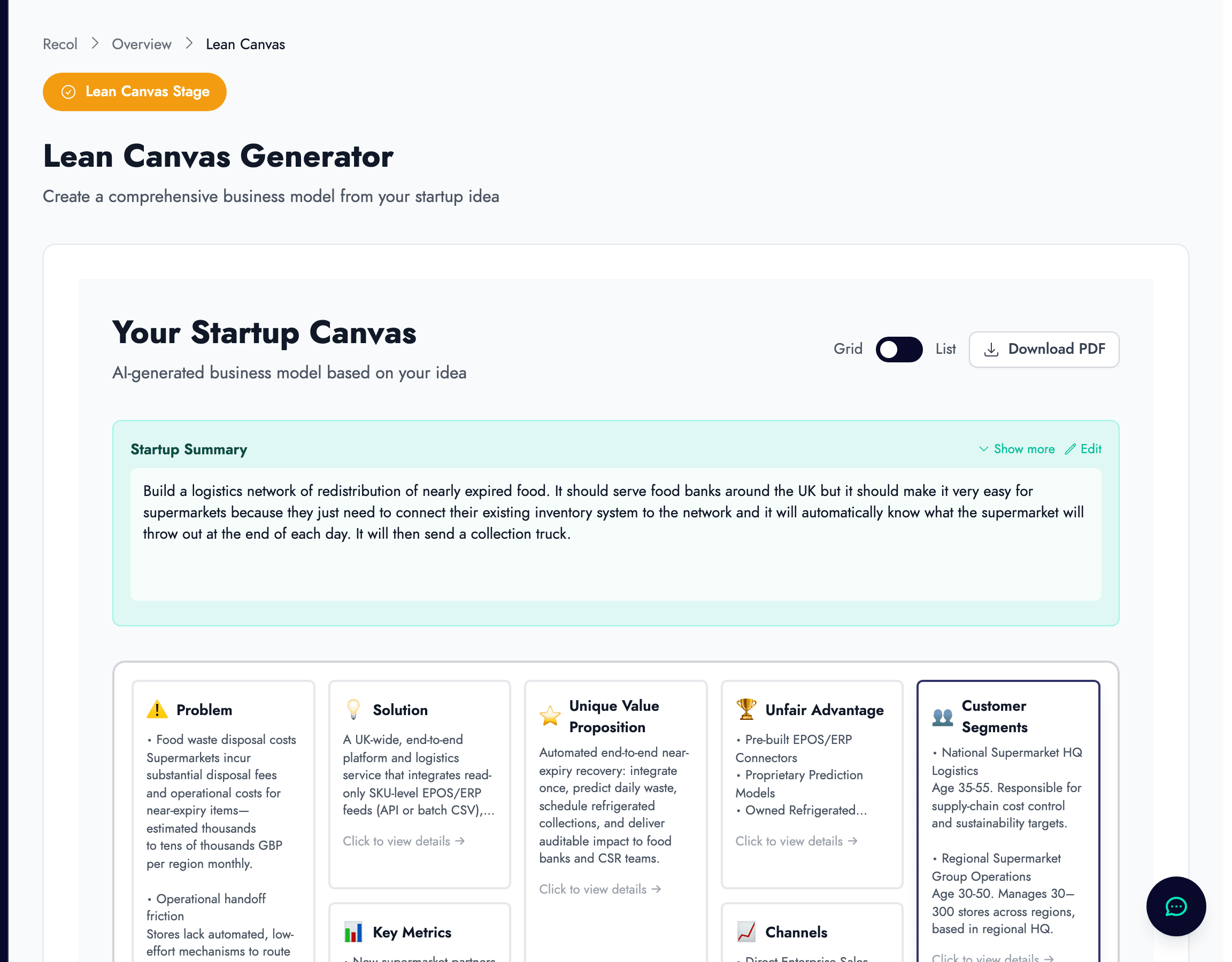
What is a Lean Canvas?
A Lean Canvas is a single-page document that captures the most important assumptions about your business. It has ten sections, each covering a different aspect of how your startup will work: who your customers are, what problem you are solving for them, how you will reach them, how you will make money, and what advantages you have that are difficult for others to copy.
The Lean Canvas was created by Ash Maurya as an adaptation of the original Business Model Canvas, with modifications specifically for early-stage startups. The key difference is that the Lean Canvas focuses on problems, solutions, and risks — the things that are most uncertain at the start — while the original canvas was designed for businesses that already know their model.
Think of it as a map of your current best thinking. It is not a business plan. It is not a pitch. It is a structured way to make your assumptions visible before you act on them.
Why the Lean Canvas comes before everything else
Most first-time founders want to start by building. They have an idea, they feel the excitement, and they want to see it work. That impulse is natural — but acting on it too early is one of the most common reasons startups fail.
The most common reason startups fail is not that the technology did not work. It is that nobody wanted what was built. Founders spend months or years building a product before they find out whether there is real demand for it. The Lean Canvas is designed to prevent that outcome by making you articulate your assumptions before you invest significant time or money.
You should complete your Lean Canvas before writing a single line of code, before designing a product, and before spending significant money. It takes one to two hours to fill in. That is a very small investment compared to six months of building something nobody uses. Most importantly, it creates the foundation from which almost every other step in zigzag flows.
The ten sections, filled in the right order
Start with the Problem section. List the top one, two, or three problems your target customers face. Be specific. "People have trouble managing their finances" is too vague to test. "Freelancers struggle to track business expenses across multiple client projects without an accountant" is specific enough to act on.
Define your Customer Segments next: who exactly experiences the problems you just described? Give them a concrete description. Then fill in your Unique Value Proposition — one clear statement explaining why your solution is different and worth choosing.
The Existing Alternatives section is often underestimated. Write down what your target customers currently do to solve the problem without you. This is almost never "nothing." Customers use spreadsheets, hire someone manually, switch between multiple tools, or simply live with the frustration. Knowing this shapes your entire product strategy.
The remaining sections — Solution, Channels, Revenue Streams, Cost Structure, Key Metrics, and Unfair Advantage — flow from the first three. Fill in your best current guess for each. Perfection is not the goal. The goal is to have your full set of assumptions on one page so you can start deciding which ones to test.
The most common mistakes first-time founders make
The first mistake is writing what you hope is true rather than what you actually believe. If you are not sure whether your target customers have a specific problem, that uncertainty belongs in the canvas. Do not assume it away. The whole point is to make assumptions visible, not to paper over them.
The second mistake is treating the canvas as a one-time document. It is designed to be updated. If your Lean Canvas looks exactly the same after three months of talking to customers, that is almost always a sign that you are not listening carefully enough. Expect it to change — version two will almost certainly look different from version one.
The third mistake is filling it in alone. Completing the canvas with your co-founders will surface disagreements early. Disagreements at this stage are valuable. They are much cheaper to resolve on paper than after months of building in different directions.
What the Lean Canvas is not
The Lean Canvas is not a business plan. Traditional business plans run to dozens of pages, take weeks to write, and are typically out of date before the ink is dry. You do not share your Lean Canvas with investors — that is what your pitch deck is for.
It is also not a commitment to a specific strategy. Do not treat your first canvas as a contract with yourself. Expect your understanding to evolve as you learn. The version you write today is simply your best current guess. The goal is to make that guess explicit so you can test it systematically.
How the Lean Canvas connects to everything that follows
Your Lean Canvas is the foundation for nearly everything else you will do in zigzag. The critical hypotheses that the platform helps you identify come directly from the assumptions embedded in your canvas — the things that need to be true for your business to work. Your validation interview questions are built around testing those hypotheses.
When it is time to work on your brand identity, elevator pitches, and startup name, zigzag draws on the customer segments and unique value proposition from your canvas. When you generate MVP requirements, market research, and a pitch deck, the canvas is still the reference point. Every major step connects back to the business model you articulated here.