How this feature connects to others
Builds on
Feature overview
What a competitive analysis is
A competitive analysis is a document that maps the competitive landscape of your market. It identifies the main alternatives to your product — direct competitors (companies solving the same problem in a similar way) and indirect competitors (companies solving the problem differently, or adjacent solutions that customers use instead).
For each competitor or category, you examine their approach, their target customer, their pricing model, their key strengths, and their notable weaknesses. You then explain how your product is positioned relative to all of them.
Where founders commonly go wrong
The most common mistake in competitive analysis is claiming to have no competitors. This claim almost always signals one of three things: the founder has not looked carefully enough, the founder is not counting the manual workarounds and adjacent tools that customers use today, or the problem is not painful enough for anyone to have built a solution yet — in which case the market question deserves more scrutiny.
Investors know this. A founder who claims no competition comes across as either uninformed or evasive. The honest version of "no competitors" is "the existing solutions are not designed specifically for our target customer segment" or "customers currently solve this problem with a combination of tools and manual work, not dedicated software." That is a differentiation story — and it is far more credible.
How to think about differentiation
Competitive analysis is most valuable when it helps you articulate specifically how your approach differs — not just "we are better," which is meaningless — but "we are different in this specific way, and that specific difference matters to this specific type of customer in this specific context."
The most compelling differentiators are ones that competitors cannot easily replicate without changing something fundamental about their business model or product architecture. Investors sometimes call these "strategic moats." If your advantage is "we are cheaper" or "we have better UX," that is a weak moat — it can be copied in a sprint. If your advantage comes from proprietary data, a unique distribution channel, or a business model that incumbents would cannibalize themselves to copy, that is worth highlighting.
How zigzag generates your competitive analysis
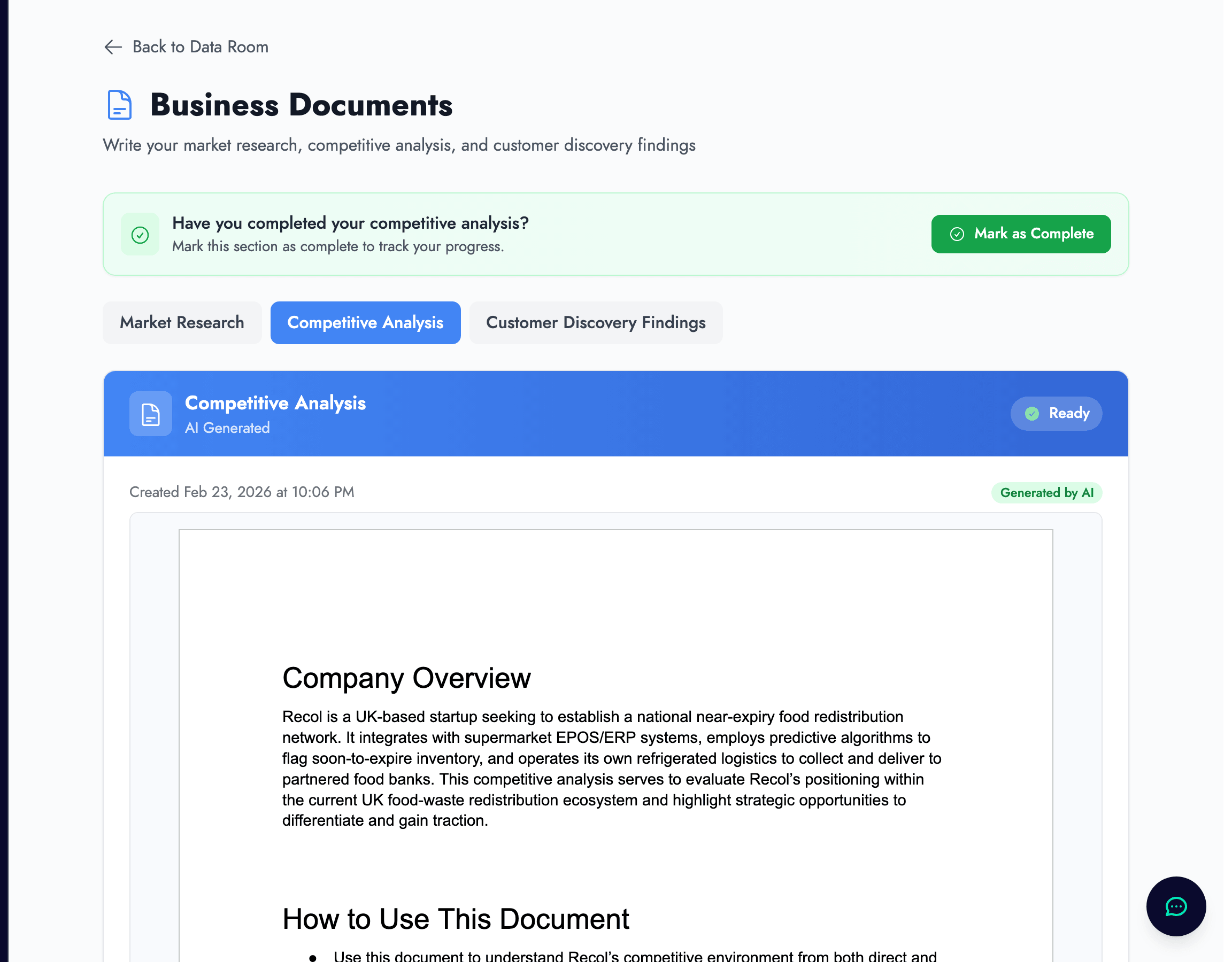
Zigzag generates a competitive analysis document as a Google Doc, drawing on your Lean Canvas — specifically the Existing Alternatives and Unfair Advantage sections — and your market research. The document structures the analysis by competitor category and includes a comparison framework.
You will need to verify the accuracy of all competitor descriptions and update anything that is out of date. Competitive landscapes shift, and an analysis with stale information can undermine your credibility with an investor who knows the space. Plan to refresh it before sharing.
How this connects to your product and your pitch
Your competitive analysis should directly inform your MVP requirements. If a key competitor has a feature set that customers have come to expect as standard, you need to decide whether to match it, replace it with something better, or explicitly exclude it from your MVP and explain your reasoning.
In your pitch deck, the competitive landscape is typically presented as a positioning map or a feature comparison. Whatever format you use, it should clearly show where your product sits relative to alternatives and why that position represents a real, defensible opportunity.