How this feature connects to others
Feature overview
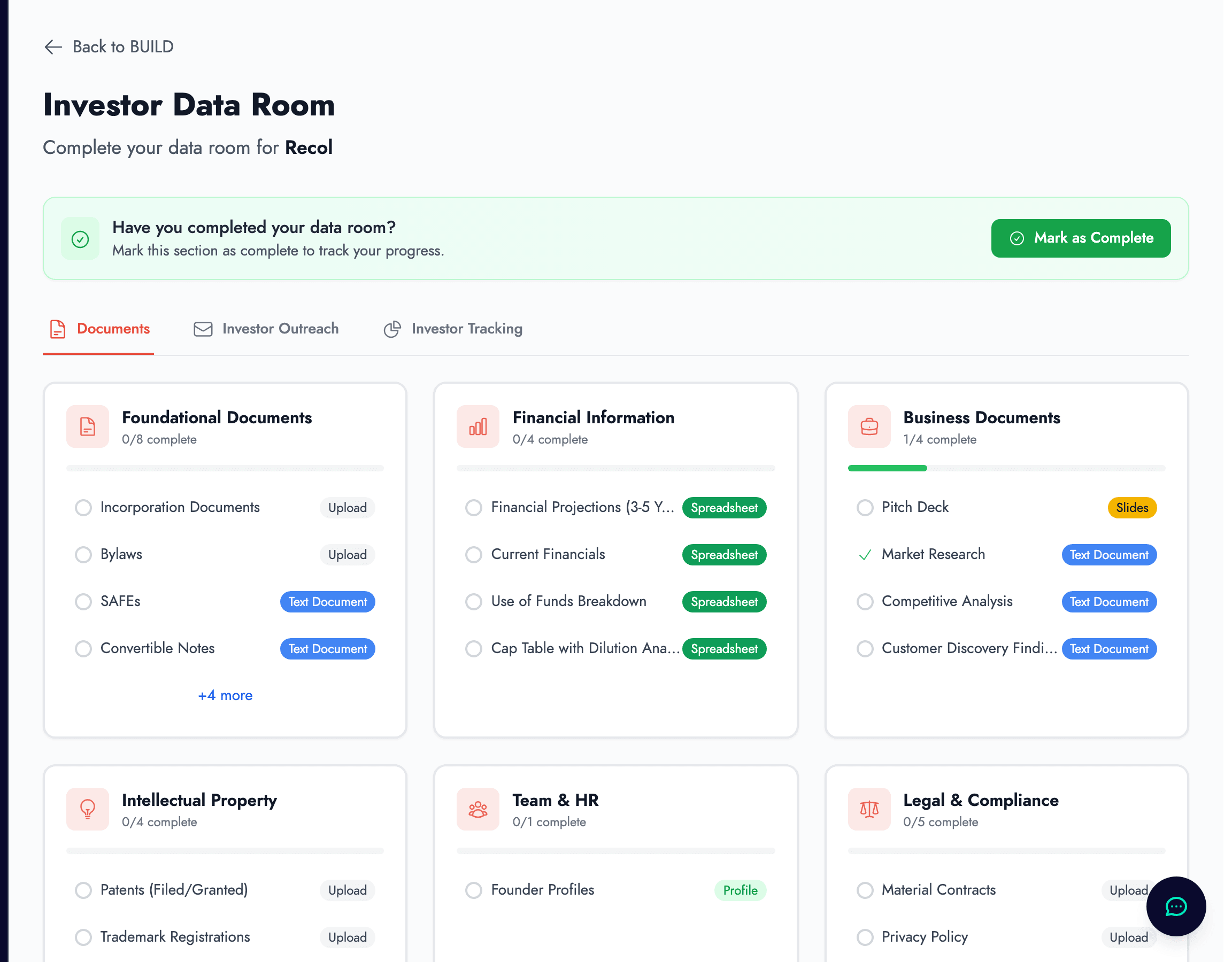
What an investor data room is
An investor data room is a digital space where you store and share the documents investors ask to review during due diligence. Due diligence is the process investors go through before deciding whether to commit capital to your startup. They want to verify the claims in your pitch and understand the details of your business at a level a presentation cannot provide.
A well-organized data room makes due diligence faster, which benefits both you and the investor. It also signals professionalism and operational discipline — founders who have their materials organized and ready demonstrate that they think carefully about preparation.
When to prepare it — earlier than you think
You should prepare your data room before you start reaching out to investors, not after you receive interest. Many founders make the mistake of waiting until an investor asks for it, then scrambling to put it together under time pressure.
Having a complete, well-organized data room ready before you begin outreach means you can respond immediately when an investor expresses interest. Response time matters in fundraising. Investors are evaluating multiple opportunities simultaneously, and a fast, organized response signals both momentum and competence.
What the data room contains
Zigzag organizes the data room into four sections. Documents: your pitch deck, market research, competitive analysis, and customer discovery findings — the materials investors use to understand your market and business. Financials: your financial projections, current financials if you have revenue, use of funds breakdown, cap table, and traction metrics. Founders: profiles for each team member, including role, LinkedIn URL, and optionally a CV or bio. Files: any additional uploads such as product demos, prototypes, case studies, or legal documents.
The four sections:
- ✓Documents: Pitch deck, market research, competitive analysis, customer discovery
- ✓Financials: Projections, current financials, use of funds, cap table, traction
- ✓Founders: Team profiles, LinkedIn, CVs
- ✓Files: Product demos, prototypes, legal documents
Access control and viewing analytics
The zigzag data room includes access controls built in. You generate a unique share link for each investor. When an investor accesses the data room, they verify their identity with a six-digit code sent to their email.
You can track which documents each investor has viewed and how much time they spent on each one. This information is genuinely useful: if an investor spent a long time on your financial projections, that is a signal of interest or of a question forming. If they opened the data room but only viewed the pitch deck, you know what they have and have not yet seen.
Keeping the data room current
Your data room is not a one-time document. As your company progresses, you will update it. New financial projections replace old ones. New traction data gets added. New product screenshots reflect recent development.
Before sharing the data room link with a new investor, review it to make sure everything is current. Outdated data or obvious inconsistencies will prompt questions that are easy to avoid with a few minutes of maintenance.
The relationship between the data room and the pitch deck
The pitch deck and the data room serve different purposes in the investor relationship. The pitch deck tells a story — it is designed to generate excitement and convey a compelling vision in a short meeting. The data room provides evidence — it is designed to satisfy a careful examiner who wants to verify the claims in the story.
The pitch deck comes first in the investor conversation. The data room comes later, when there is genuine interest. When an investor says they want to learn more after your pitch, the data room is what you share next.