How this feature connects to others
Builds on
Feeds into
Feature overview
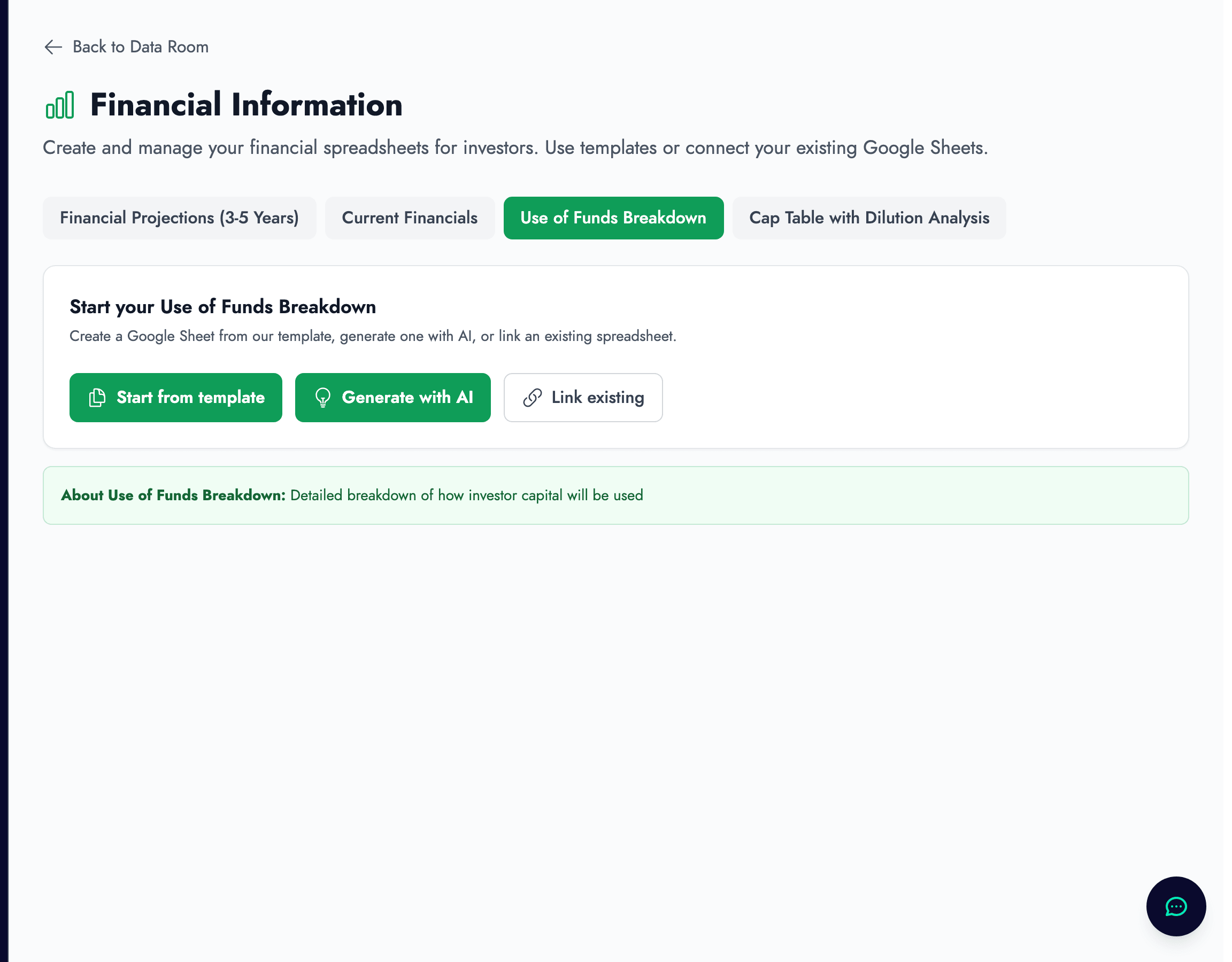
What a use of funds breakdown is
A use of funds breakdown is a document that specifies how you plan to allocate the capital you are raising. For example: forty percent to engineering and product development, thirty percent to sales and customer acquisition, twenty percent to operations and infrastructure, and ten percent to general and administrative costs.
Alongside the allocation, it should specify what milestones that capital will help you achieve. "We are raising $500,000 to build our MVP, hire two product engineers, and reach one hundred paying customers within twelve months" is the kind of statement a well-prepared use of funds document supports.
Why investors ask for this
Investors are allocating a specific amount of money for a specific period of time. They want confidence that you understand what it will cost to reach your next major milestone, and that your capital allocation reflects genuine planning rather than arbitrary percentages.
A use of funds breakdown is also a commitment. It tells investors what you are planning to do with their capital. If you raise money and then spend it differently from what you communicated, that damages trust in a way that is hard to recover from. Be honest about your actual plans rather than giving investors what you think they want to hear.
How to think about runway
Runway is how long your startup can operate before it runs out of money. Most investors want to see that the capital you are raising will give you twelve to eighteen months of runway, ending at a clear milestone that would justify a follow-on funding round.
If your numbers result in less than twelve months of runway, either your raise amount needs to increase, your cost structure needs to come down, or your timeline to key milestones needs to be shorter. Getting this math right and being able to explain it clearly is a core part of investor readiness.
How zigzag generates this document
Zigzag generates your use of funds breakdown based on your MVP requirements, your team structure, and the cost assumptions you enter. It produces a Google Sheets document with a breakdown by category and a timeline of projected milestones.
You should review and adjust every number carefully. The generated version uses general assumptions as a starting point; your actual costs will depend on your location, your team's compensation expectations, your technology infrastructure, and your specific go-to-market approach. The spreadsheet is a framework — you provide the accuracy.
The relationship between use of funds and your pitch deck
The use of funds section is one of the most carefully examined parts of a pitch deck. It is also one of the most common places where founders make avoidable mistakes — round numbers with no clear reasoning, or allocations that do not match the company's stated priorities.
Preparing a detailed use of funds spreadsheet first, and then summarizing it on a pitch deck slide, produces a much more credible presentation than writing the slide in isolation. The underlying spreadsheet is something investors may ask to see during due diligence. Having it ready and consistent with your pitch deck slide demonstrates that your numbers are real, not invented.